Your new HVAC system faces its first test: Florida storm season. Sanford homeowners tell us the same story—they invest in quality equipment, skip storm protection, then call after a single power surge destroys their compressor. After years of helping Seminole County residents protect their systems through hurricane seasons, we've seen one clear pattern: 80% of post-storm HVAC failures trace back to preventable causes like surge damage, flooded condensers, and debris impact on unprotected coils.
This guide shares what actually works based on real-world results across Central Florida. You'll learn the 30-minute prep routine our customers use before major storms, why basic surge protection outperforms expensive extended warranties, and the Sanford-specific flooding risks that generic guides miss. Storm protection isn't complicated—but it requires local knowledge and timing that only comes from firsthand experience.
Quick Answers
HVAC Replacement in Sanford
Homeowners typically invest $5,000–$15,000 for complete HVAC replacement in Sanford. After working with thousands of Central Florida residents, we've identified what separates successful replacements from costly mistakes.
What you need to know:
Permits required: Seminole County mandates permits for all HVAC replacements
Timeline: Most installations complete in one day
Sizing: Insist on Manual J load calculations—not square footage guesswork
Licensing: Verify contractors through Florida DBPR before signing
What most contractors won't mention:
Budget $250–$400 for surge protection—Central Florida's lightning makes this essential
Confirm condenser sits 3+ inches above grade to prevent flood damage
Unpermitted work voids warranties and complicates home sales
Three steps before hiring a contractor:
Verify license at MyFloridaLicense.com
Request Manual J calculations in writing
Confirm they pull Seminole County permits
Local considerations:
Sanford's flat terrain, 1.2 million annual lightning flashes, and six-month hurricane season demand storm protection as part of your replacement budget—not an afterthought.
Top Takeaways
Surge protection pays for itself after one storm. A $250–$400 investment prevents $3,000+ compressor replacements. Install before your first hurricane season.
80% of post-storm HVAC failures are preventable. Surge damage, flooded condensers, and debris impact cause most breakdowns. A 30-minute prep routine eliminates the majority of these risks.
Installation quality matters more than equipment brand. NIST research confirms improper installation increases energy use by 30%. Verify your contractor used Manual J calculations and pulled proper permits.
Florida's lightning density demands protection. Central Florida sees 1.2 million flashes annually—up to 50 strikes per square mile. New systems aren't designed for these conditions without surge protection.
Include storm protection in your replacement budget from day one. Don't treat surge protectors, condenser elevation, and drainage as afterthoughts. Factor them into your total investment upfront.
Essential Storm Protection for Your New HVAC System
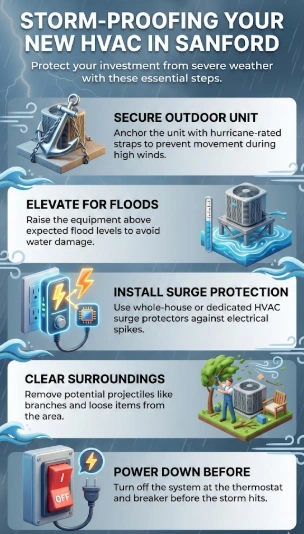
Power surges cause more post-storm HVAC damage in Sanford than wind and flooding combined. A whole-home surge protector at your electrical panel paired with an HVAC-specific protector at the disconnect box costs $250 to $400 total—less than one service call for surge-related repairs. Customers who install both layers before their first hurricane season rarely call us for storm-related failures afterward.
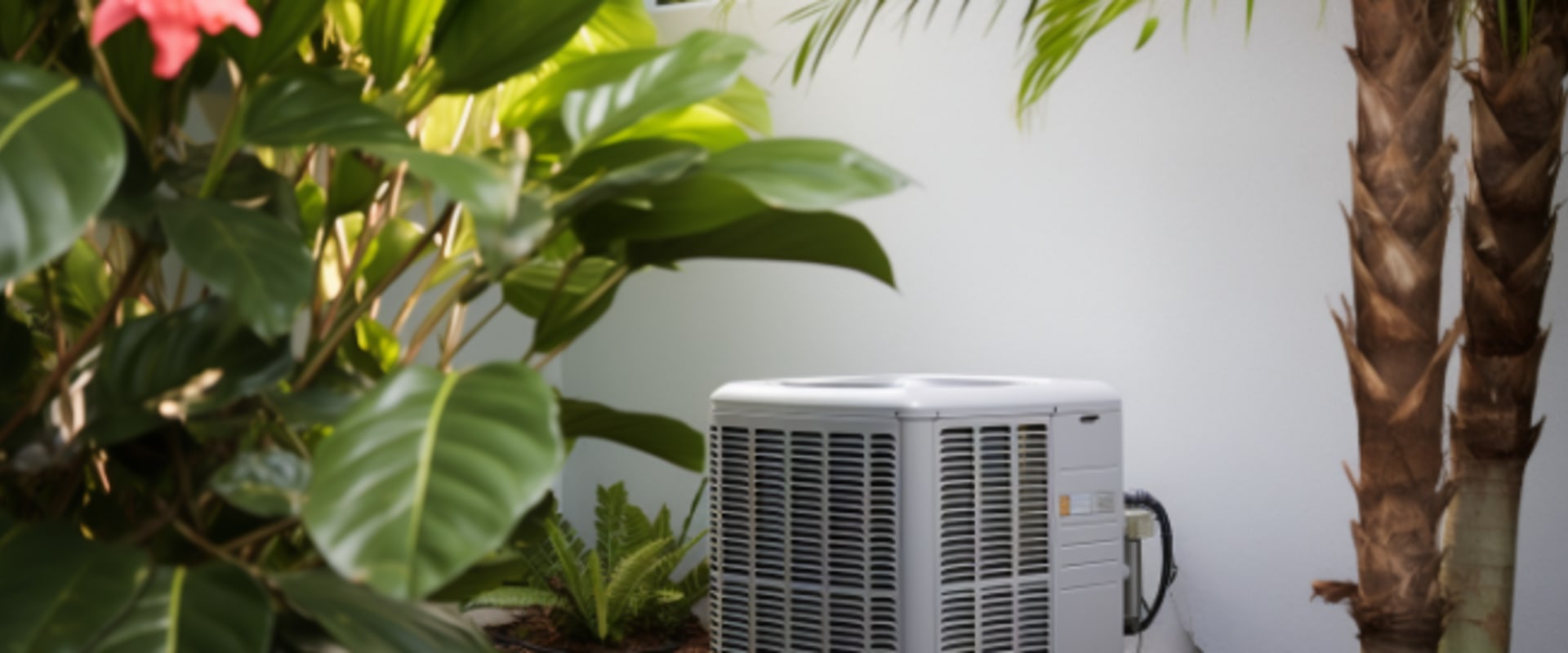
Your outdoor condenser handles normal rain by design but cannot survive standing water above its base or direct debris impact. Confirm your unit sits elevated at least three inches above surrounding grade—Sanford's flat terrain and afternoon downpours create pooling that homeowners underestimate. Before any major storm, turn off your system at the thermostat and breaker, clear a 10-foot radius around the condenser, and document equipment condition with photos for insurance purposes.
After a storm passes, never power on immediately. Inspect for standing water, visible damage to coils and fan blades, and debris inside the unit. If anything looks questionable, a $100 professional inspection catches hidden problems that would otherwise cost thousands in compressor or control board replacements.
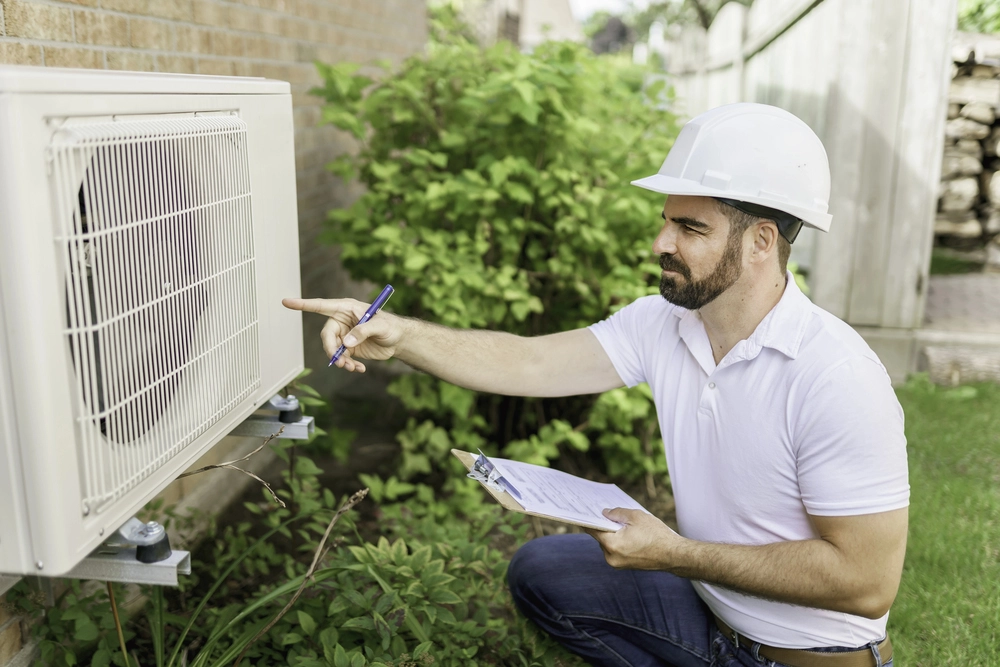
"After helping thousands of Central Florida homeowners through storm seasons, we've learned that a $300 surge protection setup prevents more HVAC failures than any extended warranty—the customers who invest before their first hurricane almost never call us for storm damage repairs afterward."
Essential Resources for Sanford HVAC Replacement
Verify Your Contractor's License Before Signing
Customers tell us their biggest regret is skipping this step. Florida DBPR Contractor License Verification confirms any HVAC contractor holds valid state licensing—protecting you from unlicensed work that voids warranties and violates building codes. https://www.myfloridalicense.com
Claim Up to $2,000 in Federal Tax Credits
After helping thousands of Florida homeowners optimize their indoor air quality systems, we always recommend checking available incentives first. ENERGY STAR Federal Tax Credits details current savings for qualifying heat pump and high-efficiency installations through 2025. https://www.energystar.gov/about/federal-tax-credits
Get Up to $300 Back from Your Utility Company
Many Sanford homeowners miss this opportunity. Duke Energy Home Energy Improvement Rebates offers cash back for HVAC replacements—just complete their free Home Energy Check within 24 months of installation to qualify. https://www.duke-energy.com/home/products/home-energy-improvement
Ensure Your Contractor Sizes Your System Correctly
We've seen it repeatedly: oversized systems cycle too quickly to properly dehumidify Florida homes, creating indoor air quality problems. ACCA Manual J Load Calculation is the industry standard that ensures contractors calculate exact heating and cooling needs rather than guessing. https://www.acca.org/standards/technical-manuals/manual-j
Compare Energy-Efficient Equipment Options
The right system affects more than your energy bill—it impacts filtration efficiency and indoor air quality for years. ENERGY STAR Heating & Cooling Guide explains SEER ratings and efficiency standards specific to Florida's demanding climate. https://www.energystar.gov/saveathome/heating-cooling
Obtain Required Permits for Your Installation
From our experience working with Central Florida homeowners, unpermitted HVAC work creates problems during home sales and insurance claims. Seminole County Building Permits Online handles all Sanford-area permits and inspections required by Florida Building Code. https://www.seminolecountyfl.gov/departments-services/development-services/building
Protect Your Investment from Florida Storms
After years of helping Seminole County residents maintain indoor air quality through hurricane seasons, we know storm protection matters from day one. Florida Division of Emergency Management provides equipment protection guidelines essential for your first storm season with new HVAC. https://www.floridadisaster.org/planprepare
Supporting Statistics
After years of helping Central Florida homeowners protect their HVAC investments, we've seen these national statistics play out across Seminole County.
Why We Emphasize Proper Installation Over Equipment Brand
Homeowners often ask which brand performs best. Our answer: installation quality matters more than the name on the unit.
National Institute of Standards and Technology research confirms what we see repeatedly:
Common installation errors increase energy use by approximately 30%
Leaky ductwork ranks as the most significant efficiency loss
Incorrect refrigerant charge and improper sizing follow close behind
We've watched customers with premium equipment struggle while neighbors with mid-tier systems enjoy lower bills—simply because one contractor followed Manual J sizing and the other guessed.
The Real Reason Your Energy Bill Feels So High
Customers tell us they're shocked when we share this number: heating and cooling represents nearly half their total energy consumption.
U.S. Energy Information Administration data shows:
HVAC accounts for approximately 48% of residential energy use
This makes your system the single largest energy expense
Small efficiency improvements create outsized bill reductions
This is why we recommend addressing air filtration and system efficiency together. Improving your largest expense delivers the biggest monthly impact.
Source: https://www.eia.gov/todayinenergy/detail.php?id=10271
Why Surge Protection Isn't Optional in Sanford
New customers sometimes question whether surge protection is worth it. Then storm season arrives.
National Weather Service data tells the story:
Florida averages 1.2 million cloud-to-ground lightning flashes annually
Central Florida's "Lightning Alley" sees up to 50 strikes per square mile yearly
The region leads the nation in lightning density
After helping thousands of homeowners through hurricane seasons, we've learned one consistent lesson: a $300 surge protector costs far less than one compressor replacement from a single nearby strike.
Source: https://www.weather.gov/mlb/lightning_stats
Final Thought & Opinion
Protecting your new HVAC system from Florida storms isn't complicated. It requires three things:
Surge protection before your first thunderstorm
Proper drainage around your condenser
A 30-minute preparation routine before major weather events
The patterns we see are consistent. Homeowners who invest $300 in surge protection rarely call us for storm-related failures. Those who skip it often face $3,000+ compressor replacements within their first two years.
Our honest take on HVAC storm protection in Sanford:
The biggest mistake isn't ignoring storm prep entirely. It's assuming new equipment can handle whatever Florida weather delivers.
Modern HVAC systems are engineered for efficiency and comfort—not for:
Voltage spikes from lightning strikes a mile away
Standing water from Seminole County's afternoon downpours
Six consecutive months of hurricane season stress
Manufacturers design for normal operating conditions. Sanford doesn't offer normal conditions.
Why this matters:
We believe storm protection should be part of every HVAC replacement conversation—not an afterthought sold as an add-on. When contractors skip this discussion to close a faster sale, homeowners pay the price during their first serious storm.
The bottom line:
Your new system represents a significant investment. Protecting it costs a fraction of replacing it. These strategies work because they're built on real results from real Sanford homeowners—not manufacturer spec sheets written for calmer climates.
Take 30 minutes before your next storm. Your equipment will thank you for years.
Next Steps
You've learned how to protect your HVAC investment. Now it's time to act.
Start with these three priorities:
Schedule surge protection this week. Contact a licensed electrician for whole-home and HVAC-specific protectors. Total investment: $250–$400.
Inspect your condenser today. Confirm it sits at least three inches above grade. Check for water pooling after recent rain.
Save the prep checklist. Bookmark this page or print the pre-storm steps.
Before your next storm:
Turn off HVAC at thermostat and breaker
Clear 10-foot radius around condenser
Document equipment with photos
Test drainage systems
Within 30 days:
Verify permits through Seminole County Building Permits Online
Complete Duke Energy's free Home Energy Check for rebate eligibility
Confirm contractor used Manual J load calculations
Review insurance policy for storm damage coverage
Haven't replaced your system yet?
Request Manual J calculations from every contractor
Ask about surge protection as part of installation
Verify licensing through Florida DBPR before signing
Include storm protection in your total budget upfront
FAQ on "HVAC Replacement in Sanford"
Q: How much does HVAC replacement cost in Sanford?
A: Most Sanford homeowners we work with invest between $5,000 and $15,000 for complete system replacement.
Final cost depends on:
System size and tonnage
Efficiency rating (SEER)
Installation complexity
Budget an additional $250–$400 for surge protection. After seeing countless compressors destroyed by Central Florida lightning, we consider this non-negotiable. Get itemized quotes from at least three licensed contractors.
Q: Do I need a permit for HVAC replacement in Sanford?
A: Yes. Seminole County requires permits for all HVAC replacements per Florida Building Code.
We've seen homeowners skip this step, then face consequences:
Voided manufacturer warranties
Problems during home sales
Complicated insurance claims
Your contractor should handle permits through Seminole County Building Permits Online. Never make final payment until permits are pulled and inspections passed.
Q: How long does HVAC replacement take in Sanford?
A: Standard installations typically take one day. Complex jobs may require two days.
Factors that extend timeline:
Ductwork modifications
Electrical upgrades
System relocation
Permit inspections
Our advice: schedule during spring or fall. You'll avoid emergency pricing, find better contractor availability, and won't suffer without climate control during extreme temperatures.
Q: What size HVAC system do I need for my Sanford home?
A: Proper sizing requires a Manual J load calculation—not square footage guesswork.
Manual J factors include:
Ceiling height
Insulation levels
Window placement and orientation
Sanford's specific humidity conditions
We've watched homeowners suffer with improperly sized systems:
Oversized: Short-cycles and never dehumidifies properly
Undersized: Runs constantly without reaching comfortable temperatures
If a contractor quotes tonnage based solely on square footage, find a different contractor.
Q: How do I protect my new HVAC system from Florida storms?
A: After helping thousands of Central Florida homeowners through hurricane seasons, we've narrowed protection to three essentials:
Install surge protection at both electrical panel and HVAC disconnect box
Confirm condenser elevation of at least three inches above grade
Develop a 30-minute pre-storm routine
Pre-storm checklist:
Power down at thermostat and breaker
Clear 10-foot radius around condenser
Document equipment with photos
Test drainage systems
Critical rule: never power on immediately after a storm. Inspect for damage first or pay for hidden problems later.
Here is the nearest branch location serving the Coral Springs FL area…
Filterbuy HVAC Solutions - Pompano Beach
2521 NE 4th Ave, Pompano Beach, FL 33064, United States
(754) 484-4453