17x22x1 vs 17x22x4 Air Filters: Is the Upgrade Worth It?
TL;DR
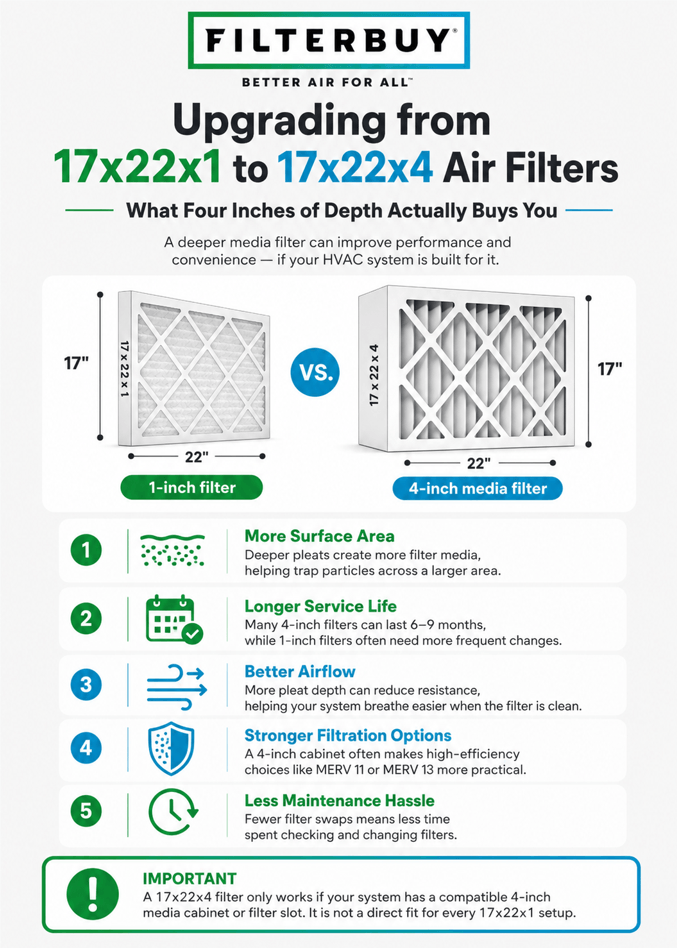
A 17x22x4 air filter will not slide into a 17x22x1 slot. Both share an identical face of 16.5 by 21.5 inches and differ only in depth, so the upgrade is a duct modification rather than a filter swap. If your return already has a four-inch media cabinet, the deeper filter gives you lower airflow resistance at the same MERV rating and roughly two changes a year instead of four to six.
Is the 17x22x4 Upgrade Worth It?
For homes that already have a four-inch media cabinet, yes. The extra depth holds more dust before airflow suffers, which is what protects freshly cleaned ductwork. Over five years, the intervals compound: 20 to 30 one-inch filters against 5 to 10 four-inch ones. If you only have a one-inch slot, you are budgeting for a cabinet retrofit first.
Key Takeaways
A 17x22x4 does not fit a 17x22x1 slot. Same face, nearly five times the depth.
Depth buys media; media buys time. Four-inch filters run 6 to 12 months against 60 to 90 days for one-inch.
Deeper is usually less restrictive, because the same airflow spreads across more surface at lower velocity.
Bypass beats MERV. Air travelling around a filter is never cleaned, whatever rating you bought.
Filterbuy lists the 17x22x4 at 16.50 x 21.50 x 3.63 inches and the 17x22x1 at 16.50 x 21.50 x 0.75 inches.
Will a 17x22x4 Filter Fit Where My 17x22x1 Goes?
No. A 17x22x4 is roughly 3.63 inches deep and will not enter a slot cut for a 0.75-inch filter, though both measure 16.5 by 21.5 across the face and look interchangeable in a photo. Moving from one inch to four requires a media cabinet, a fabricated deeper rack, or a return-grille housing built for the depth.
That retrofit is routine work for a contractor, and it is the step homeowners skip. Skipping it is how people wedge a filter into a slot that will not close, creating the very bypass gap the upgrade should eliminate. Before ordering, work through how to measure a furnace or AC air filter properly: actual dimensions decide whether the depth fits, not the label.
How to Tell Which Housing You Already Have
You can identify your housing in two minutes with a tape measure. Turn the system off, then find the filter at the air handler, in the return plenum beside it, or behind a return grille.
A One-Inch Slot
A one-inch slot is a narrow gap covered by a thin panel or sheet metal on two screws, no door. The filter slides in edgewise. If its edge sticks out, or the cover won't sit flush, it is already leaking air.
A Media Cabinet
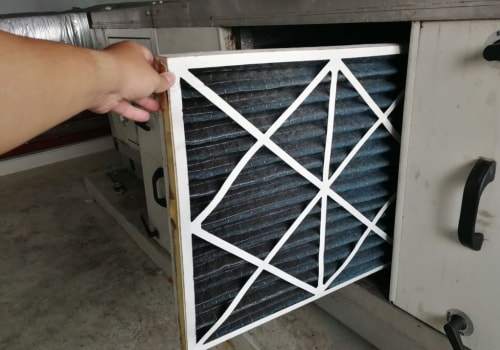
A media cabinet is a boxy sheet-metal housing bolted between the return duct and furnace, six to eight inches wide, with a hinged door. The filter seats inside a frame.
Then measure what you removed. At roughly 16.5 x 21.5 x 0.75 inches, you need a retrofit. At 16.5 x 21.5 x 3.63, the cabinet is there, and you can order today.
What Four Inches of Depth Actually Buys You
Depth buys pleated media, which buys airflow headroom and time between changes. Because the two sizes get written about as interchangeable, I pulled Filterbuy's published specifications for both and compared them line by line. The face measurements came back identical to the hundredth of an inch. Only depth moves.
That reframes the upgrade. You are not buying a better filter. You are buying room for more of the same pleated media, and room is something your return either has, or it doesn't.
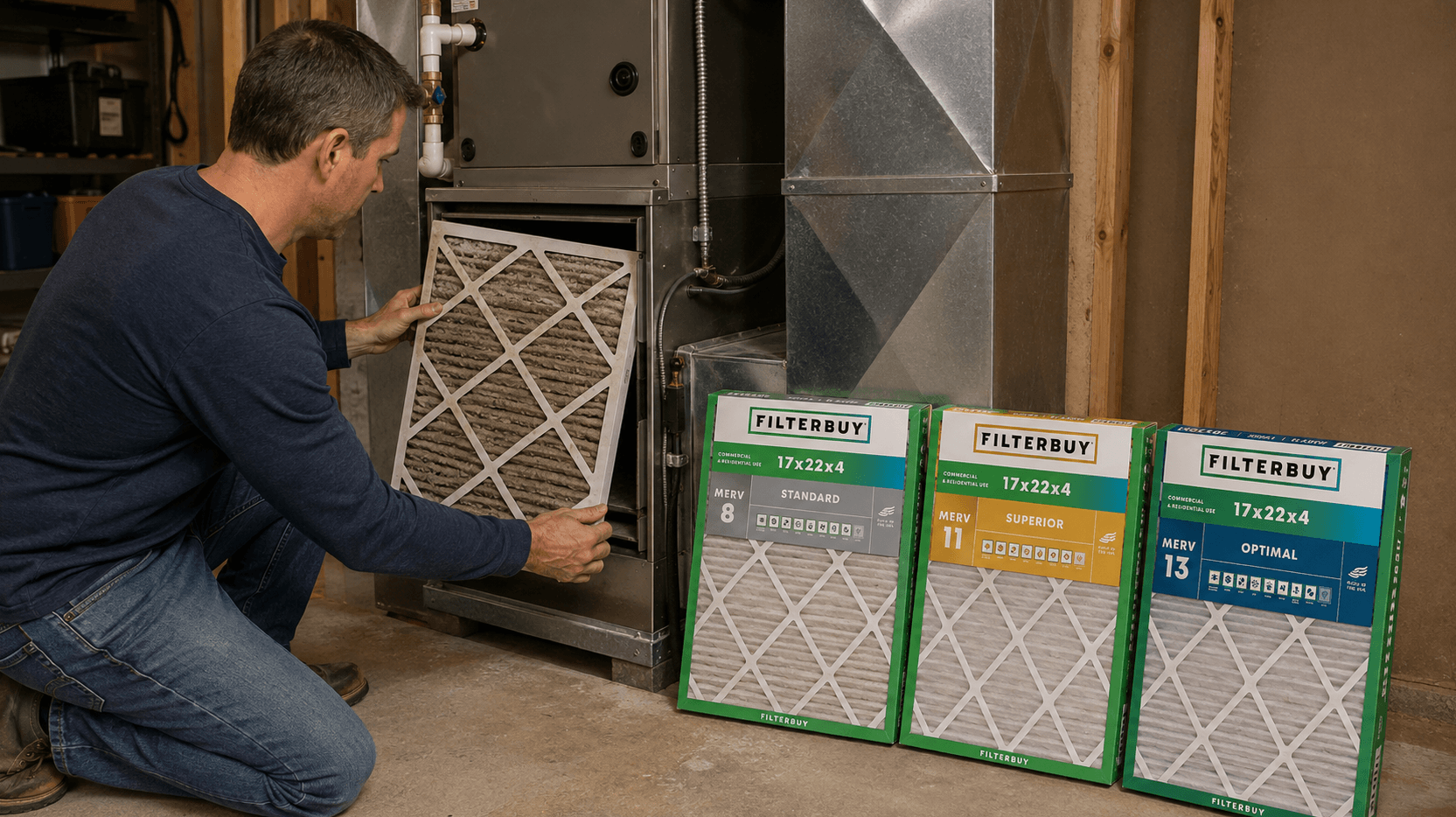
The 17x22x4 is stocked in MERV 8, MERV 11, and MERV 13. Confirm that before paying for a cabinet you can feed with only one grade, and if unsure, start with what a MERV rating measures.
Why This Matters More Right After a Duct Cleaning
A cleaning resets the system; filtration decides how long the reset lasts. A four-inch cabinet seals the filter against a gasketed frame, so return air has nowhere to go but through the media. A one-inch slot with a bent cover, or a filter half an inch too small, lets unfiltered air run straight back into ducts you just paid to clean.
The EPA is direct about prevention: use the highest-efficiency filter your manufacturer recommends, change it regularly, and make sure air cannot bypass the filter through gaps around the holder. It does not recommend routine cleaning, only cleaning as needed. That is the pattern behind dust returning weeks after a professional cleaning.
When You Should Not Upgrade
Skip the cabinet in four situations where the constraint sits somewhere other than the filter.
Undersized return ductwork. If debris is restricting airflow in the ducts themselves, filtration treats the symptom.
Equipment near its static pressure limit. A technician measures this in minutes with a manometer.
A cabinet you cannot reach. A filter fighting the furnace to access won't get changed.
You are moving within a year. The payback is real but slow.
"The complaint I hear most often isn't that a duct cleaning didn't work. It's that it didn't last. When I ask what filter went back in afterward, it's almost always the same thin one that was there before, in a slot whose cover no longer sits flush. Handing a clean duct system back to a filter that leaks around its own frame is how people pay twice."
-Jill Simpson, writer, best-duct-cleaning.com
Essential Resources on 17x22x4 Air Filters
1. Confirm Your Exact Dimensions and MERV Options
Verify the actual dimensions your housing must accept, and which grades are stocked, before anything gets cut. Canadian readers can check the same size on Filterbuy's Canada catalogue.
Source: Filterbuy 17x22x4 Air Filters
2. Learn the One Filter Mistake That Undoes a Duct Cleaning
The EPA's homeowner guide covers when duct cleaning is warranted, when it isn't, and the prevention steps that keep ducts clean afterward, including checking for bypass at the holder.
Source: EPA, Should You Have The Air Ducts In Your Home Cleaned?
3. Check Whether Your System Can Handle the MERV You Want
ASHRAE, which wrote the standard MERV is measured against, recommends MERV 13 as a minimum, with the caveat that your equipment decides, and confirms you should seal the filter in its slot.
Source: ASHRAE, Filtration And Disinfection FAQ
4. Watch What Filter Bypass Actually Looks Like
The National Air Filtration Association hosts a short expert video on air filter bypass, the failure this upgrade exists to prevent, and how it changes what you look for at the frame.
Source: NAFA, Basics Of Air Filtration
Supporting Statistics
1. A 4-Inch Filter Cuts Airflow Resistance Roughly 40% at Equal MERV
The Department of Energy compares three MERV 7 filters from one manufacturer at 300 feet per minute: the 1-inch measures 0.20 inches of water column, the 4-inch measures 0.12. Same rating, same maker; depth the only variable. Filters account for 20% to 50% of total system pressure drop, and most homes run efficiently at or under 0.5 in. w.c.
Source: Building America Solution Center, High-MERV Filters
2. The Default Filter in Most Systems Is a One-Inch MERV 8
The American Lung Association reports that HVAC systems usually take a one-inch filter and that the factory default is low-efficiency at around MERV 8, so upgrading to MERV 13 captures more small particles. It puts those filters at about $12 each, changed every two months.
Source: American Lung Association, Air Cleaning
3. MERV 13 Is at Least 85% Efficient on 1 to 3 Micron Particles; MERV 8 Is Around 20%
The CDC's National Institute for Occupational Safety and Health puts MERV 13 at a minimumof 50% efficiency even in the 0.3 to 1.0 micron range. A four-inch cabinet is what makes that jump practical at home, because it absorbs the resistance that stops one-inch systems from going there.
Source: CDC/NIOSH, Ventilation FAQs
Final Thoughts and Opinion
Deep-pleat filters are sold on efficiency, but after reading spec sheets and federal test data side by side, I think depth is really buying forgiveness. A one-inch filter punishes you for forgetting. A four-inch filter in a sealed cabinet gives you months of margin.
Two positions that run against most coverage here. The MERV debate is overrated: once the cabinet exists, the resistance penalty for MERV 13 largely disappears. And the seal is badly underrated. A MERV 8 sealed properly beats a MERV 13 with a finger-width gap at the frame, because the second filters a fraction of the air it appears to. Nobody sells you a gasket, which is probably why nobody writes about one.
Next Steps
Measure your existing filter. Record all three actual dimensions, not the nominal label.
Measure the slot depth. Under an inch means a retrofit. If the face isn't 17x22, an adjacent size such as 17x25x4 in MERV 8 may fit better.
Get a static pressure reading before quoting a cabinet. Target 0.5 in. w.c. or under.
Quote the cabinet. Ask about the gasket, the latch, and whether plenum seams get sealed after the cut. If there is room, ask whether it can take a stock size like 20x20x4 in MERV 11, which is cheaper per filter.
Pick your MERV once the cabinet exists. With four inches of media, MERV 13 is realistic for most systems.
Inspect at six months. Judge the media, not the calendar. Gray across the whole face means change it.
Frequently Asked Questions
Q: Can I Stack Four 17x22x1 Filters to Make a 17x22x4?
A: No. Stacking multiplies resistance without adding usable surface area, and the seams create bypass paths. Use one filter built for the housing depth.
Q: How Often Should a 17x22x4 Filter Be Changed?
A: Most run 6 to 12 months, but inspect monthly. Pets, construction dust, or wildfire smoke cut that roughly in half, and heating-season run hours load a four-inch filter faster than mild weather.
Q: Does a Higher MERV Always Restrict Airflow More?
A: At the same depth, yes. Depth changes the math: a four-inch MERV 13 spreads airflow across far more media than a one-inch MERV 13 and typically runs at lower resistance. Above MERV 13, the trade-off returns, and comparing MERV 14 against true HEPA shows why HEPA isn't practical in a residential return.
Q: What Should I Ask the Contractor Before Installing a Cabinet?
A: Your total static pressure, whether the cabinet door seals on a gasket, and whether plenum seams get sealed after the cut. That last one gets skipped most often, and you cannot inspect it once the panel is back on, so get it in writing.
Q: My Slot Is 17x22, but Only Takes 1-Inch. What Now?
A: Fit a pleated 17x22x1 at the highest MERV your system tolerates, change it every 60 to 90 days, and close any gap at the slot with tape or a gasket. Filterbuy lists 17x22x1 at an actual 16.50 x 21.50 x 0.75 in the same three grades, so you can raise efficiency now and decide about the cabinet later.
Ready to Get the Right Depth in Your Return?
Four inches only pays off when the filter matches the housing exactly. Start with a tape measure rather than a shopping cart, then order the depth your system was built to take.
Learn more about HVAC Care from one of our HVAC solutions branches…
Filterbuy HVAC Solutions - Miami FL - Air Conditioning Service
1300 S Miami Ave Apt 4806 Miami FL 33130
(305) 306-5027
https://maps.app.goo.gl/Ci1vrL596LhvXKU79